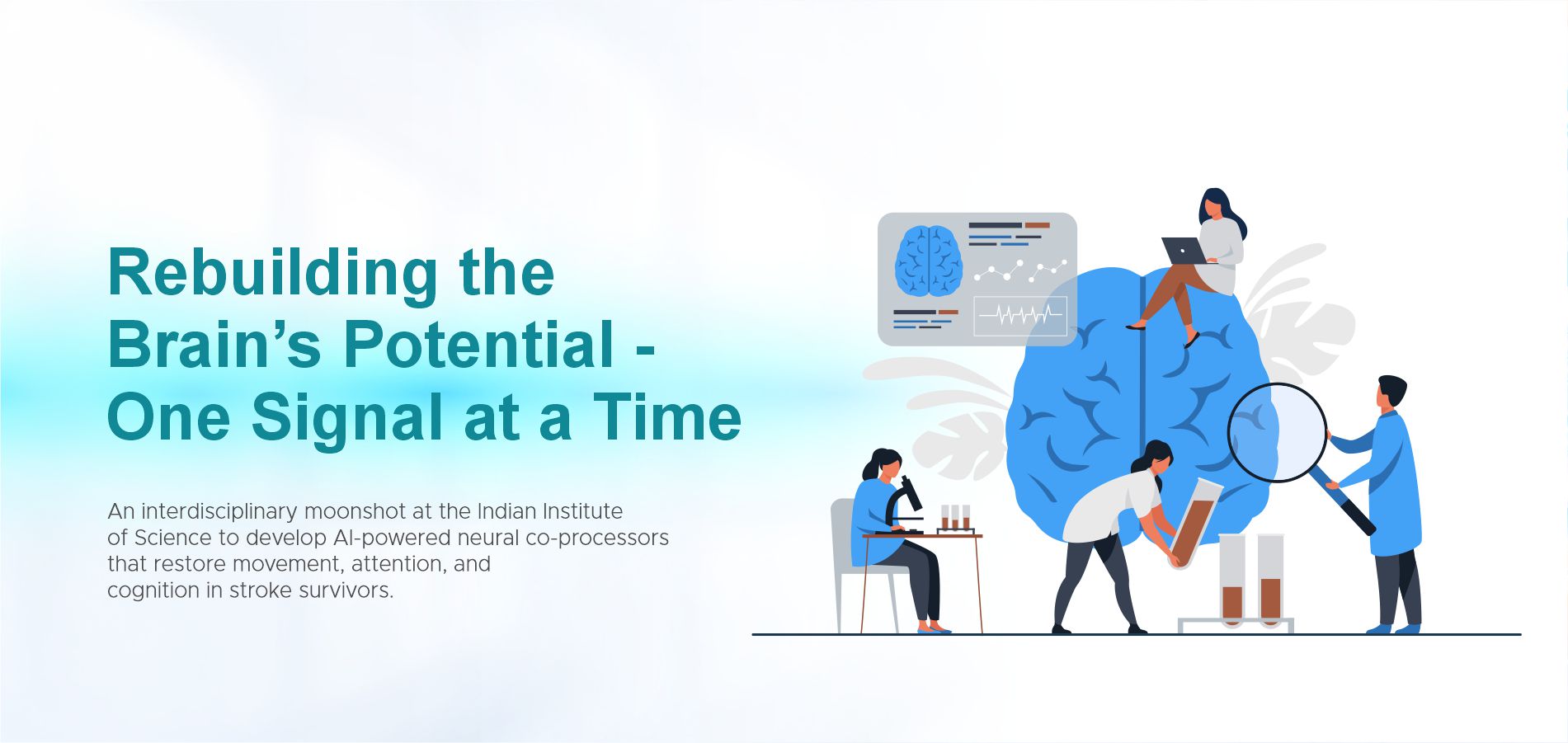
Rebuilding the Brain’s Potential — One Signal at a Time
An interdisciplinary project at the Indian Institute of Science to develop AI-powered neural co-processors that restore movement, attention, and cognition in stroke survivors.
Introduction
Every year, hundreds of thousands of Indians experience a stroke and many are left without the use of their hands, arms, or the cognitive abilities they once took for granted. Stroke of the middle cerebral artery, one of the most common types, can simultaneously rob a person of the ability to see clearly, pay attention, make decisions, and reach for an object.
The Brain Co-Processors project asks a simple but profound question: what if a device could do what the damaged brain no longer can? Not a prosthetic that bypasses the brain, but an intelligent co-processor that works in concert with it reading its signals, understanding its intent, and sending it back the information it needs to act.
“We are building a new generation of AI-powered brain interfaces, grounded in the brain’s own distributed computational logic, to restore goal-directed action in stroke survivors.”
The Challenge
Goal-directed action — something as simple as picking up a cup of tea — requires the seamless coordination of vision, attention, decision-making, and motor control. After a stroke, any or all of these can break down. Current rehabilitation technologies address these one at a time. We address all of them together.
Impact at a Glance
0+
Strokes occur annually across India, affecting millions of people nationwide each year
0M+
Indians with epilepsy benefiting from our tools improving care and outcomes
0 Years
Two phase roadmap guiding transition from non invasive to implantable co processors
0 Teams
Cross-disciplinary neuroscience, engineering, AI, clinical teams
How It Works: The Three-Tier Approach
Tier 1 Fundamental Knowledge
We begin by understanding how the healthy human brain encodes vision, attention, decisions, and movement. Using intracranial recordings in epilepsy patients and non-human primates, we build the world’s most detailed map of the neural circuits underlying goal-directed reaching.
Tier 2 Enabling Technology
We develop indigenous, low-cost brain recording and stimulation hardware electrodes, chips, and neuromorphic processors that can interface with the brain at scale and in real time.
Tier 3 Systems Integration
We combine scientific insights with novel hardware to build a closed-loop neural co-processor: a device that reads the brain’s intent, processes it with AI, and sends back corrective signals to restore coordinated reaching in stroke patients.
Why Choose Tolkio?
Experience the Difference with Intelligent Assistance
Lorem ipsum dolor sit amet consectetur. Eu tortor eget sed amet tortor enim iaculis ultricies sit. At arcu amet nisi scelerisque aliquam diam. Netus in elementum euismod orci praesent nibh.