
We design and synthesise next-generation materials and fabricate OLED devices that drive breakthroughs in electronics and bio-integrated technologies
Organic Light-Emitting Diodes (OLEDs) are advanced display and lighting technologies that utilize organic materials to emit light in response to an electric current. Unlike traditional liquid crystal displays (LCDs), OLEDs are self-emissive, enabling deep blacks, high contrast ratios, and vibrant colors. Additional advantages of OLEDs over conventional lighting devices include their flexibility, lightweight structure, foldability, faster response times, and wider viewing angles, making them ideal for applications such as smartphones, televisions, and wearable devices.
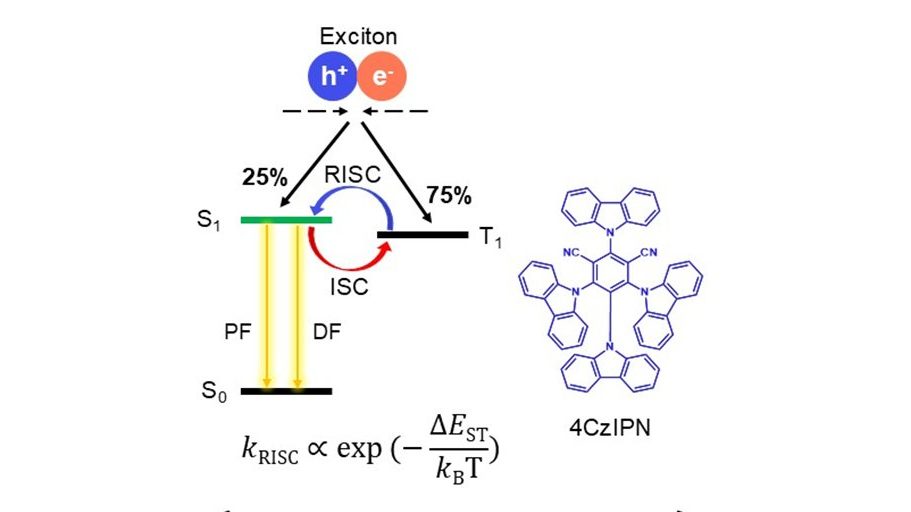
Thermally Activated Delayed Fluorescence (TADF) is a photophysical process in which dark triplet excitons can contribute to light emission via delayed fluorescence using room temperature thermal energy. By designing suitable molecular structures with a small singlet–triplet energy gap (ΔEST) of less than 0.2 eV, efficient upconversion of triplet excitons to the singlet excited state through reverse intersystem crossing (RISC) becomes feasible. TADF emitters can achieve 100% internal quantum efficiency (IQE) without the use of heavy metals such as iridium (Ir) or platinum (Pt), making them a cost-effective and sustainable alternative to phosphorescent emitters. TADF materials have found significant applications in organic light-emitting diodes (OLEDs), offering bright emission, tunable colors, and extended device lifetimes.
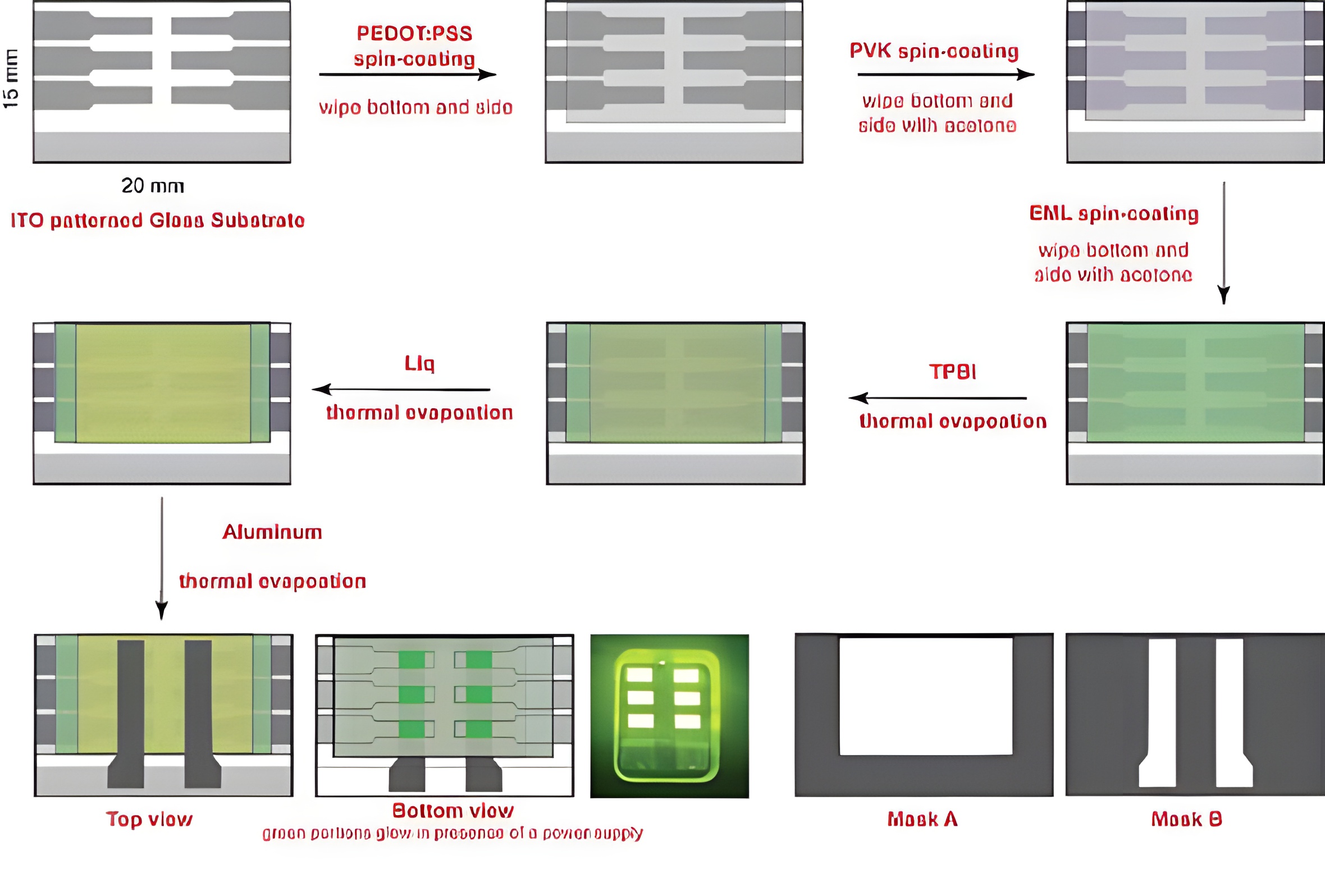
The solution-processed device fabrication proves to be efficient due to being cost-effective, highly scalable and environmentally sustainable. It demands less material and energy consumption. In the solution processed device, emissive layer material can be deposited at low or room temperature, which makes it a suitable choice enabling fabrication on flexible and heat sensitive substrates. Infact, for those molecules which can degrade upon increased temperature, a device can be made only by this method.
In ProFM Lab, we work with different types of emissive materials (TADF, fluorescent, metal nanocluster) to form their solution-processed device. Although multi-layered OLEDs are common, single layered OLEDs are also interesting to work with. Moreover, we are working towards finding out the nontraditional alternatives of commonly used injection/transport layers.
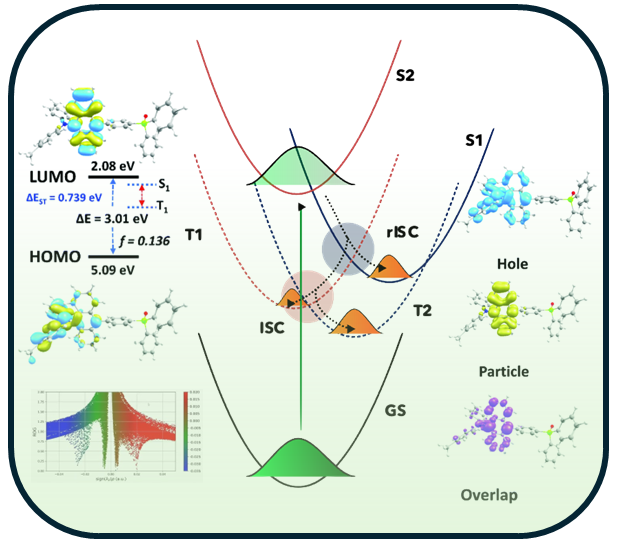
Molecules and materials that interact with light play a significant role in our daily lives, impacting technologies like displays and lighting. Thermally activated delayed fluorescence (TADF) has emerged as a promising mechanism to enhance the efficiency of organic light-emitting diodes (OLEDs) by enabling the harvesting of both singlet and triplet excitons without the use of heavy metals. A key question is how to efficiently leverage excited state properties for designing new materials with improved performance. Theoretical studies have played a crucial role in advancing the understanding of TADF mechanisms, guiding the design of new materials with optimized properties. Central to TADF is the small singlet-triplet energy gap (ΔEST), which facilitates efficient reverse intersystem crossing (RISC) under thermal activation. Quantum chemical calculations, particularly density functional theory (DFT) and time-dependent DFT (TD-DFT), have been extensively used to predict excited-state properties, analyse charge transfer character, and evaluate ΔEST. Advanced methodologies, including multiconfigurational approaches and nonadiabatic dynamics simulations, have provided deeper insights into the interplay between molecular geometry, electronic structure, and vibronic coupling effects crucial for efficient RISC. Our group employs advanced theoretical methods to understand non-equilibrium dynamics, focusing on electronically excited states. We integrate simulations with experiments to understand the excited state processes and discusses the challenges related to the accurate prediction of RISC rates and the design of next-generation DF materials.
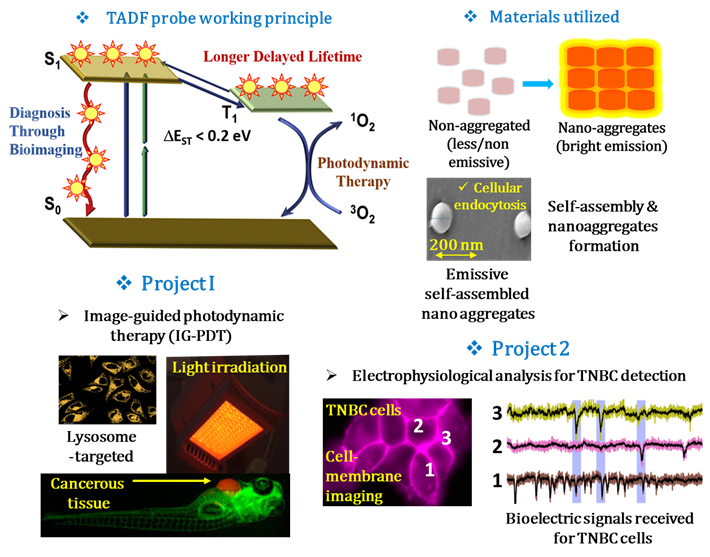
Macromolecular photosensitizers are challenging to synthesize, and often they have shorter lifetimes at their excited state, which limits their utility in image-guided photodynamic therapy (IG-PDT). To counter this, I am developing a TADF organic small molecular probe that undergoes self-assembly to form nanoaggregates in aqueous medium, displaying favorable endocytosis, organelle-targeted accumulation, and prolonged triplet-state lifetime. These TADF nanoaggregates finally become suitable candidates to be realized for organelle-targeted IG-PDT, exploring the in vitro and in vivo models. Moreover, electroluminescent probes are potential candidates to assess cellular physiology, and device-based biosensing is the need of the hour for the point-of-care detection of cancers. I am trying to understand the probable utilization of a TADF electroluminescent probe/ TADF-OLED device for the physiological assessment of cancer and normal cells to diagnose triple-negative breast cancer. Hence, my research is highly interdisciplinary and overlaps with the interface of organic synthetic chemistry, fluorescence spectroscopy, OLED device fabrication, molecular and chemical biology, and fluorescent bioimaging.
The foundation of supramolecular chemistry was laid in the late 1960s by visionaries like Charles Pedersen, Jean-Marie Lehn, and Donald Cram, who introduced macrocyclic molecules such as crown ethers, cryptands, and spherands, capable of selectively binding ions and small molecules through elegant non-covalent interactions. This groundbreaking work earned them the Nobel Prize and ignited a revolution in molecular science. Jean-Marie Lehn later coined the term "supramolecular chemistry" to describe this new frontier of chemistry beyond the molecule.
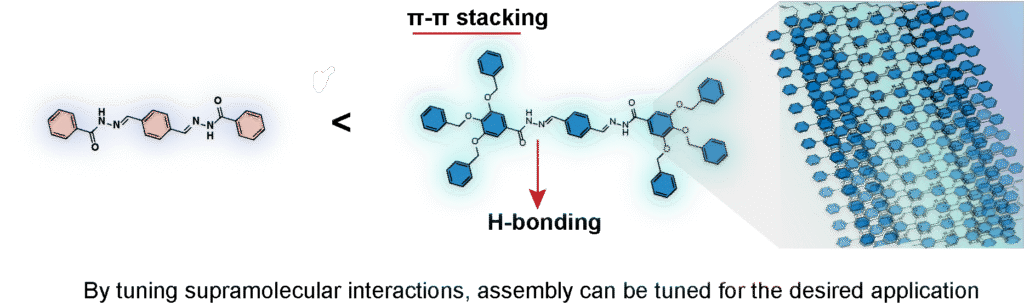
Supramolecular chemistry encompasses the design and assembly of small molecular units into complex, hierarchical architectures using a range of non-covalent forces: hydrogen bonding, host–guest recognition, electrostatic attractions, π–π interactions, hydrophobic effects, and metal coordination. These dynamic interactions allow the creation of functional, adaptive, and responsive materials that hold promise for applications ranging from catalysis and molecular recognition to drug delivery and nanotechnology.
Materials Research Centre,
Indian Institute of Science (IISc),
Bangalore – 560012 INDIA